
Simmers Crane Design and Services works alongside you to optimize lifting operations. From planning to building to installation and maintenance ‒ we ensure your equipment is mechanically and electrically sound, and ready when you need it!
One Team. One System. Better Outcomes.
Overhead cranes aren’t standalone systems. They are a vital part of your operation. Besides feeding your production facility with the raw materials, they also help you assemble and manufacture products and load finished goods. They allow you to handle loads of any size, any weight and any complexity with ease.
Simmers’ integrated approach to design, assembly, and service keeps cranes running smoothly, offering turnkey solutions at every stage based on your workflow, site conditions, and lifting requirements.
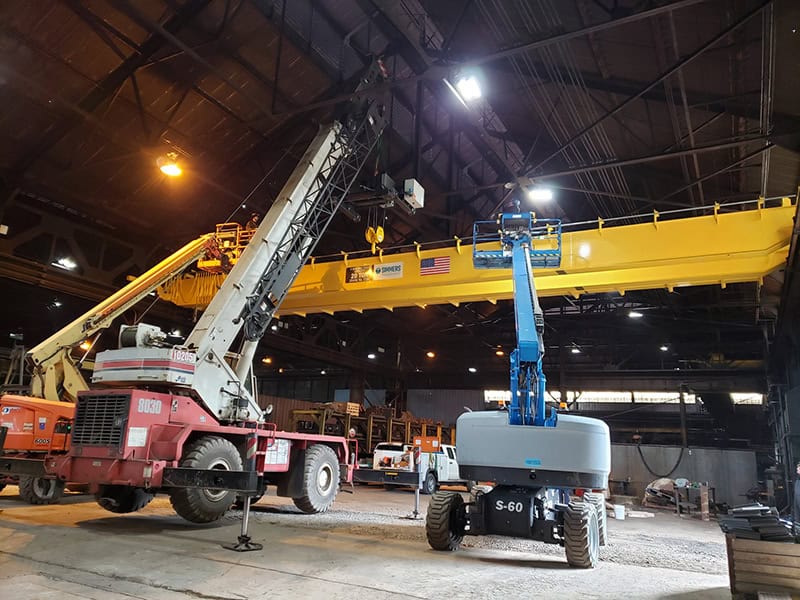
Guided by over 65 years of engineering, service, and manufacturing experience, our team builds cranes with your specific requirements in mind ‒ leading to long-lasting performance with fewer breakdowns and greater uptime.
Multi-manufacturer experience allows us to incorporate new equipment into existing infrastructure. As an OEM (Original Equipment Manufacturer) alternative, we can even replace existing, obsolete machinery with parts fabricated to the original manufacturer specifications. Such familiarity enables our engineers to diagnose root cause issues faster and more accurately, whether they’re working on our systems or another brand’s.
Overhead Crane Types & Configurations
Simmers provides powerful technical support to America’s logistics and industrial sectors, building, servicing, and modernizing all types of overhead lifting equipment.
Bridge Cranes
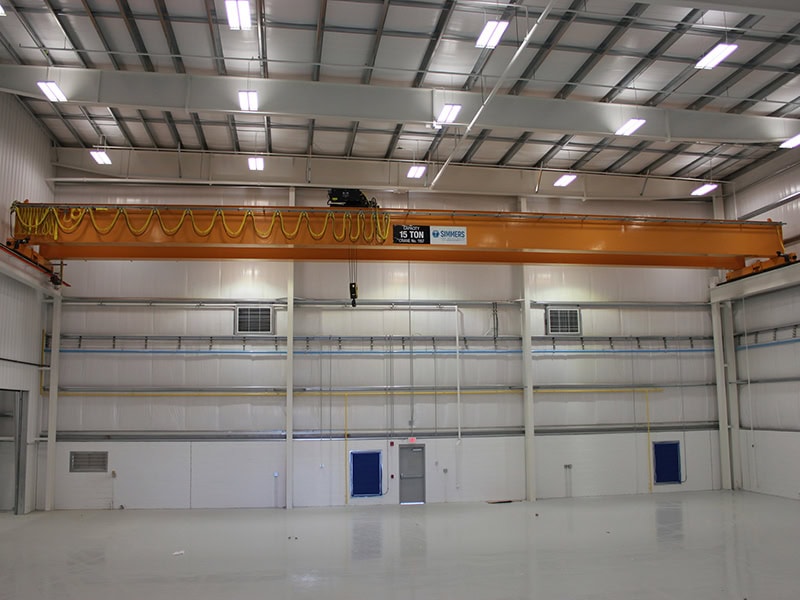
Bridge cranes are industrial machines that lift and move objects overhead, leaving the area below them free and unobstructed. They consist of a set of parallel beams called runways that typically extend the length of the building. Traveling either on top or underneath the runway is a set of parallel beams called the bridge.
The bridge consists of either a single girder or double girder configuration. These bridge beams support the trolley, which contains the hoist, the device responsible for raising and lowering objects. Together, these components allow bridge cranes to move loads in three axes and position them at any point within their operating area.
Jib Cranes
Jib cranes consist of a long boom arm connected to a freestanding column or one of the walls or columns in your facility. Freestanding jibs allow the boom to rotate 360°, while wall-mounted jibs can only rotate 180-200°. Operators move the hoist back and forth along the boom using a trolley, enabling you to lift and move loads to any point within the crane’s operational area.
Gantry Cranes
Gantry cranes are independent systems consisting of a bridge that holds the trolley and hoist, supported by two legs that move back and forth along a runway embedded in the ground. Because gantry cranes don’t depend on an existing superstructure, they are a popular choice for temporary or outdoor lifting operations.
Workstation Cranes
Sometimes referred to as ergonomic cranes, workstation cranes are lightweight, self-contained systems designed to help workers perform repetitive lifting tasks. Workstation cranes normally consist of a trolley and hoist attached to a single girder bridge and are meant for lighter lifting applications, generally 4,000 pounds or less. Workstation cranes can be freestanding or suspended from the ceiling and are typically manually operated along the X and Y axes. Workstation cranes are a great choice where lighter lifting occurs and ergonomics is vital.
Overhead Crane Safety & Compliance
Simmers builds cranes for industries that require safe and efficient material handling. Our engineers and technicians offer critical support to:
Overhead Crane Applications
Simmers builds cranes for industries that require safe and efficient material handling. Our engineers and technicians offer critical support to:
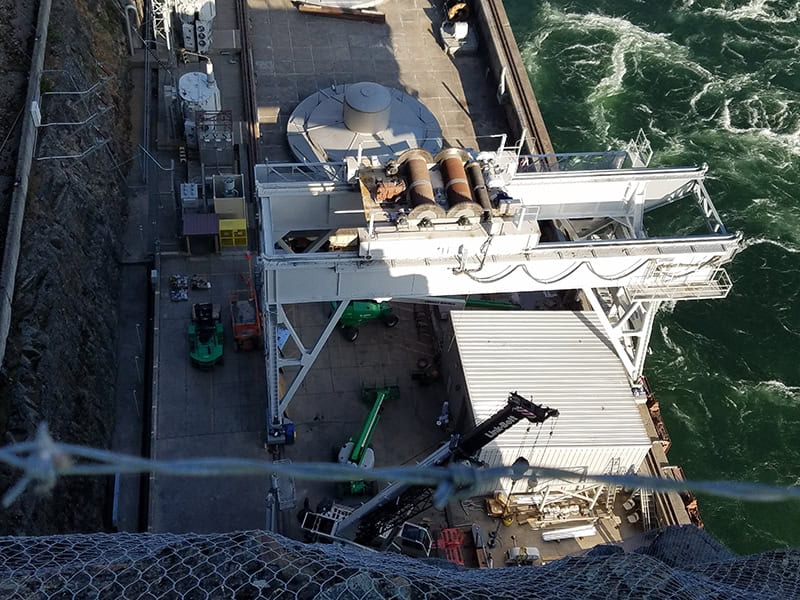
- Construction
- Primary metals
- Steel Processing
- Recycling
- Power Generation
- Pulp and Paper Production
- Logistics and Distribution
- Aerospace
- Manufacturing and Fabrication
- Gas, Oil, and Mineral Extraction
- Automotive and Vehicle Assembly
Whether you work with raw materials or finished products, Simmers provides the power, precision, and control you need to move goods efficiently through your facility.
Additional Solutions
Simmers Crane Design and Services provides comprehensive support solutions to your overhead lifting systems including:
Why Choose Simmers Crane for Overhead Crane Systems
When you split design, installation, and maintenance among several vendors, performance and accountability suffer. Simmers provides complete lifecycle support from conception to completion ‒ ensuring your equipment works better, lasts longer, and encounters fewer problems along the way.
Our engineering expertise means your cranes are built with compliance, serviceability, and long-term capacity in mind. Rather than remaining siloed, our teams collaborate to deliver smarter layouts, cleaner deployments, and stronger ROI.
Multi-manufacturer flexibility allows us to incorporate projects into your existing infrastructure and production process, blending new and current lifting equipment in order to enable efficient workflow and keep your operation moving forward.
If you’re ready for a partner willing to stand by their designs, machinery, and service from design to delivery and beyond, contact us today and discover how working with an end-to-end provider can elevate your operation.
FAQs
-
How does Simmers Crane determine the right overhead crane capacity for my facility?
Our engineers determine the right capacity for your cranes by measuring your typical load weight, the frequency of lifting operations, and the maximum weight you’ll need to lift. To prevent accidents, we add a safety margin in case you encounter unexpected weight fluctuations.
-
What are the typical lead times for custom overhead crane systems?
It depends on the size of your build. Standard lifting systems take 6-12 weeks to complete while large, complex ones normally require 16-22 weeks. Highly specialized systems need even longer lead times, at least 24 weeks or more.
-
Can you upgrade or modify existing overhead cranes?
Simmers’ engineering teams can incorporate modern technology into your existing systems to improve safety and performance. Common upgrades include load monitoring, collision avoidance, and anti-sway technology to keep loads stable while they’re being transferred.
-
Can you work with cranes from other manufacturers?
Multi-manufacturer flexibility allows us to source hard-to-find parts for a wide range of brands or, if they can’t be located, fabricate them according to the original manufacturer standards.
-
What happens if my crane breaks down outside normal business hours?
We offer 24-hour emergency maintenance. If your system breaks down outside normal hours, contact us right away for emergency repairs.
